
Is Your Nonprofit Ready for June 30th?
A Practical Guide to Year-End Close, Audit Readiness, and Financial Clarity for Small Nonprofits
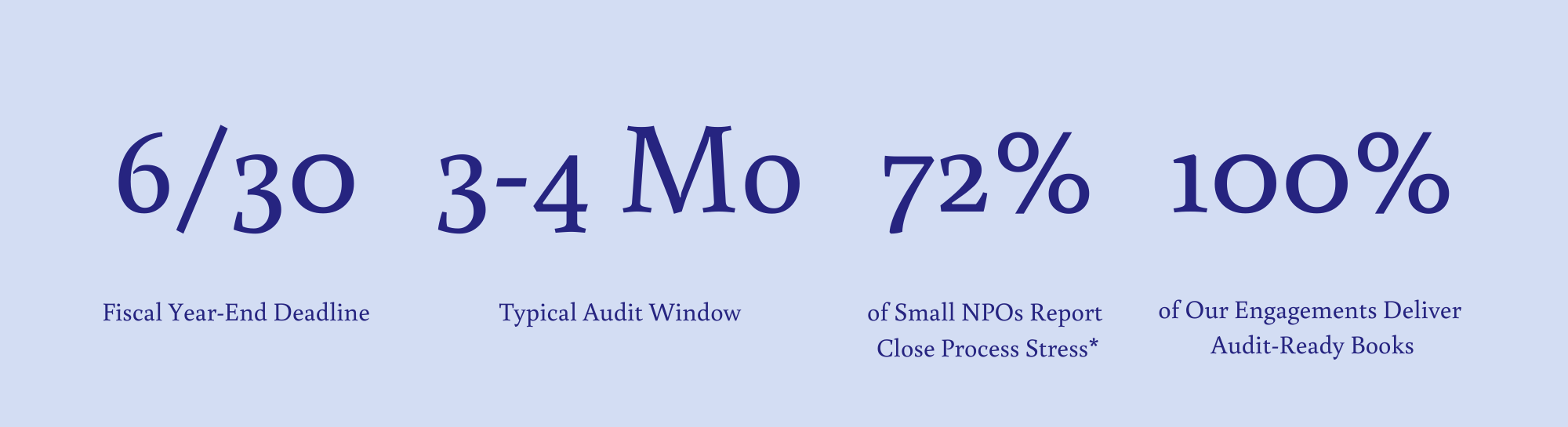
*Based on AICPA nonprofit sector surveys and industry research.
Executive Summary
The June 30th Crunch Is Real. You Do Not Have To Face It Alone.
For most small nonprofits, the weeks surrounding a June 30th fiscal year-end feel like a perfect storm: auditors are scheduled, board members are asking questions, and the finance team is buried under reconciliations that should have been done months ago.
The truth is, this stress is not inevitable. It is usually the byproduct of gaps that accumulate quietly throughout the year: a general ledger that drifted out of alignment, a reconciliation that got pushed to next month, a restricted grant that was never properly tracked. By the time the auditor arrives, those small gaps have compounded into material problems.
At Solaris Accounting Advisory, our Small Business Services division was built specifically to serve organizations like yours. We bring the technical depth of a seasoned audit and financial reporting background directly to your close process, without the cost or commitment of a full-time hire. Think of us as your financial close partner: we assess what needs to be fixed and help you cross the finish line with confidence.
This white paper walks through the most common year-end challenges small nonprofits face, what best practices look like, and how Solaris can help you get there.
Why the June 30 Year-End Is Uniquely Challenging?
Unlike December 31st entities, which benefit from a natural calendar-year slow period, June 30th organizations are closing their books during summer months when staff vacations overlap with audit preparation windows. Add to that the complexity of nonprofit accounting and you have a uniquely demanding environment.
The Nonprofit Accounting Landscape Is More Complex Than It Looks
Nonprofit financial statements carry a layer of complexity that many small organizations underestimate. Beyond the typical challenges of cash management and expense tracking, nonprofits must contend with:
Net asset classification (without donor restriction vs. with donor restriction) that must be precisely tracked throughout the year
Release from restriction accounting that requires documentation tied to each grant or gift agreement
Functional expense allocation across program, management and general, and fundraising, which is a common audit focus area
Revenue recognition nuances between exchange transactions and contributions under ASC 958 and ASC 606
In-kind contributions and donated services that must be properly valued and disclosed
For a lean finance team, often one or two people wearing many hats, keeping all of this current throughout the year is genuinely difficult. The result is a general ledger that, by June 30th, contains errors, inconsistencies, and presentation issues that must be resolved before financial statements can be issued.
Common Warning Signs We See Every Engagement
Does Any of This Sound Familiar?
Bank and investment accounts that have not been formally reconciled in months
Restricted fund balances that do not match grant tracking schedules
Prepaid expenses or accrued liabilities that were never adjusted
Journal entries with little or no supporting documentation
Functional expense allocations that were set up once and never revisited
A trial balance that does not tie to prior-year audited financials
If you recognized even two or three of those items, you are not alone. More importantly, these are all fixable. But they need to be addressed before your auditor arrives, not during fieldwork.
What Audit-Ready Actually Means
Being audit-ready does not mean having a perfect set of books. It means your books are organized, supportable, and consistent, so your auditor can move efficiently and you can answer their questions with confidence.
The Three Pillars of Audit Readiness
In our experience, audit readiness rests on three foundations that must all be in place before fieldwork begins:
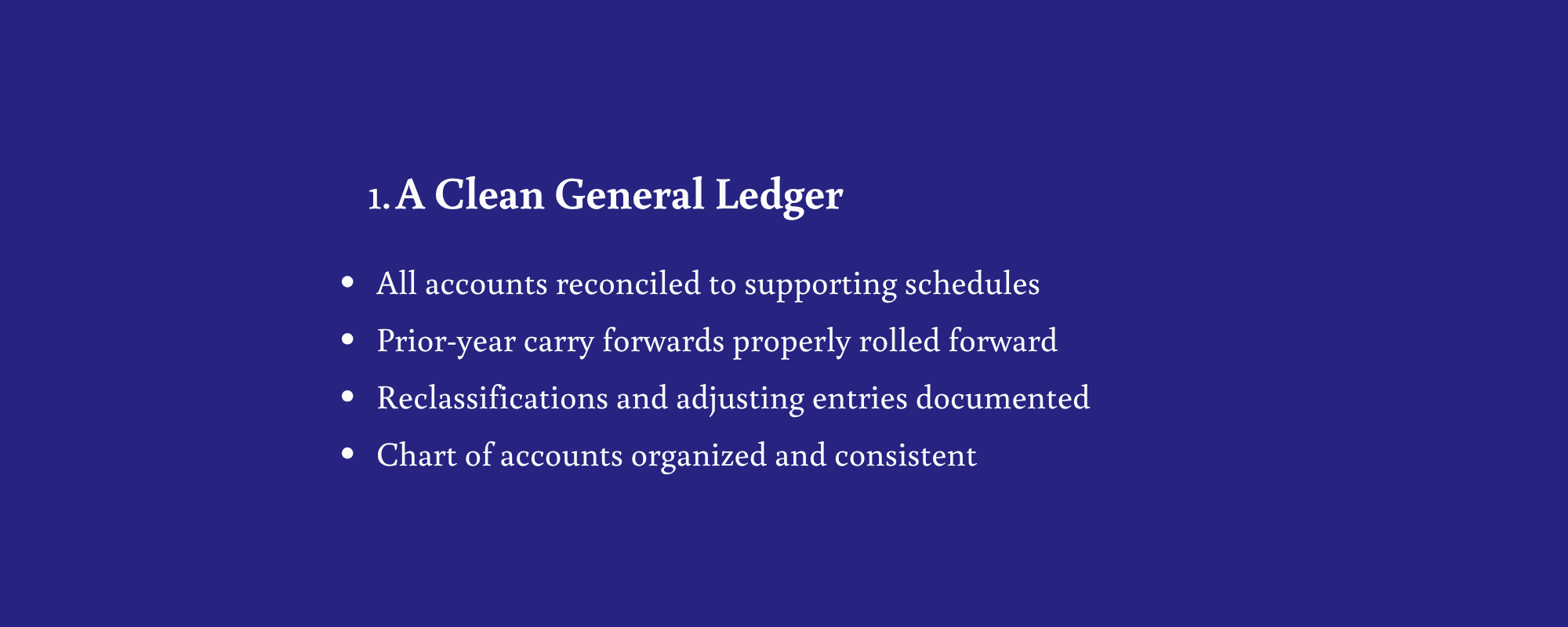
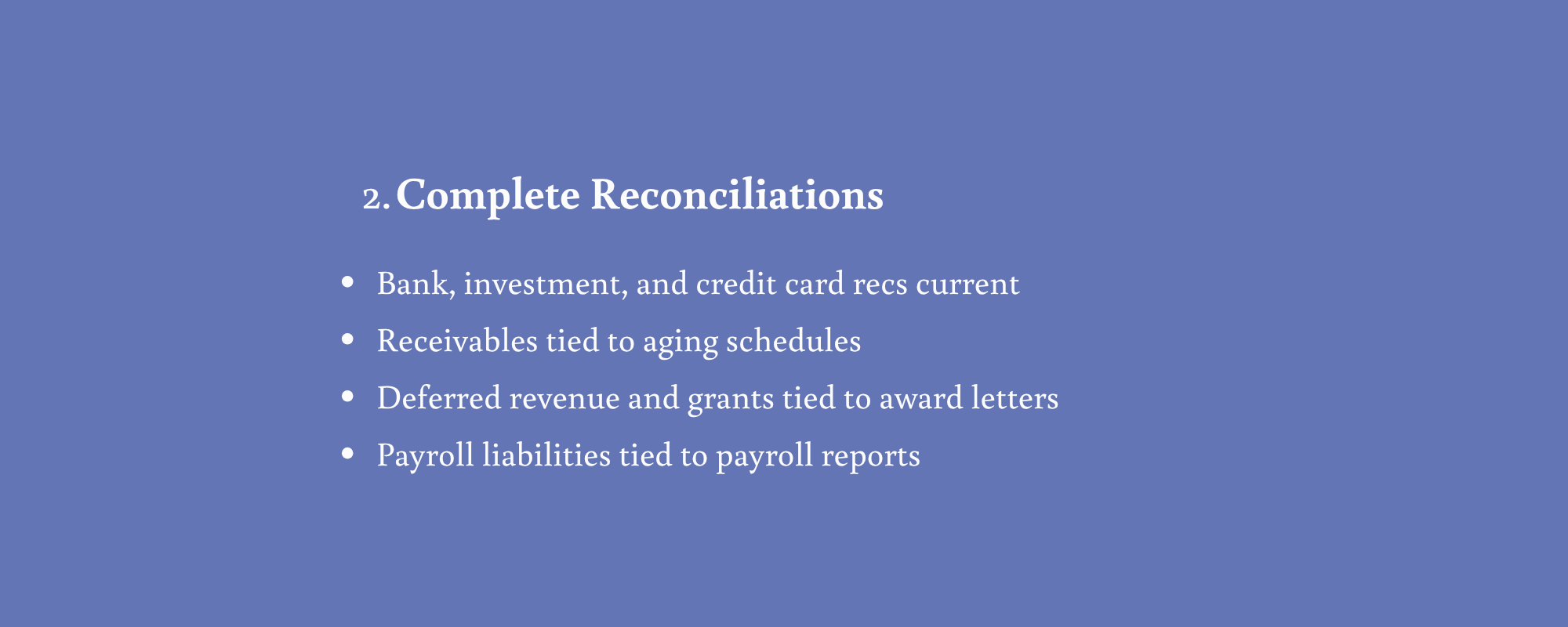
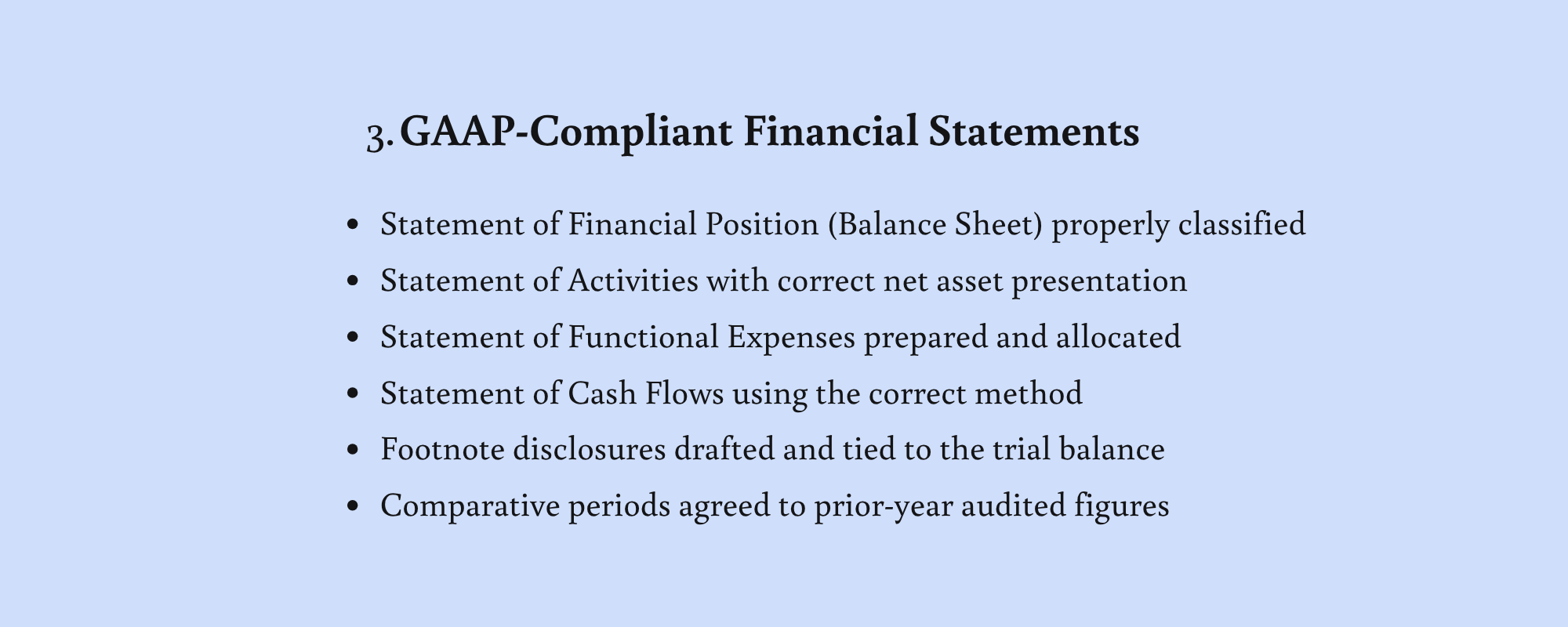
When these three pillars are in place, audit fieldwork tends to move quickly and cleanly. When they are not, the audit becomes a forensic exercise, and audit fees climb accordingly.
What We Do: Our Small Business Services for Nonprofits
Our Small Business Services division offers a suite of engagements designed specifically for small nonprofits preparing for year-end. All of our engagements are led by a manager with deep experience in private entity audit, financial statement preparation, and month-end close processes, so you are never getting a junior resource learning on the job.
The Three Pillars of Audit Readiness
For organizations that have fallen behind on their books, or that lack the internal capacity to maintain a consistent close process, we offer hands-on bookkeeping support and a structured month-end close framework. This includes:
Review and cleanup of your general ledger going back to the start of the fiscal year
Bank and account reconciliations brought current
Month-end journal entries for accruals, prepayments, and depreciation
A close checklist and recurring process designed to keep you current through year-end
We do not just fix the immediate problem. We leave you with a repeatable process so the next fiscal year starts clean.
Financial Statement Preparation
Preparing GAAP-compliant financial statements for a nonprofit is a technical exercise that goes well beyond exporting a report from your accounting software. We draft complete financial statements including all four required statements and the accompanying footnote disclosures, tied to your trial balance and presented in the format your auditors expect.
Our team brings audit-side experience to this work, which means we know exactly how auditors will review these statements and what questions they will ask. That perspective allows us to catch presentation and disclosure issues before they surface in the audit, saving you time and protecting your audit opinion.
GAAP Compliance and Technical Accounting Advisory
Nonprofit accounting is full of technical areas where errors are common and the consequences can be significant: restatements, audit findings, and donor concerns. Our advisory services address the questions that do not have easy answers:
How should this restricted grant be recognized and released?
Are these in-kind services required to be recorded, and at what value?
Does this arrangement qualify as a contribution or an exchange transaction?
How should functional expenses be allocated across program and G&A?
Is our net asset presentation correct after this board-designated transfer?
We work through these questions with you, document the accounting position, and ensure your books reflect the correct treatment before the auditor raises it as a finding.
Audit Report
Even organizations with solid internal teams can benefit from support during audit fieldwork. We serve as your liaison to the audit team, helping to:
Prepare and organize the PBC (Prepared by Client) document package
Draft responses to auditor inquiries and requests for explanation
Review audit adjustments and assess their impact on financial statements
Prepare rollforward schedules for key balance sheet accounts
Ensure management representation letters and other deliverables are completed accurately and on time
Our audit-side background means we understand what auditors are looking for, and we help you present your information in the clearest, most efficient way possible.
Fractional CFO and Strategic Finance
For organizations that need more than transactional support, our Fractional CFO offering provides senior-level financial leadership on a part-time or project basis. This is particularly valuable for nonprofits that are growing, navigating a complex grant portfolio, or experiencing leadership transitions.
Services at this level include board and audit committee reporting, budget development and variance analysis, cash flow forecasting, internal control assessments, and strategic financial planning. You get the experience and perspective of a seasoned finance leader, engaged at the level your organization actually needs.
Identifying and Addressing Weaknesses in Your Close Process
One of the most valuable things we do in every engagement is hold up a mirror to your current process. Not to be critical, but to identify the specific gaps that are creating risk.
Every organization has a close process, even if it is informal. Our job is to assess that process against best practices, identify the specific gaps that create audit risk or financial reporting exposure, and help you address them in a way that is practical for your team's size and capacity.
Common Process Gaps We Address
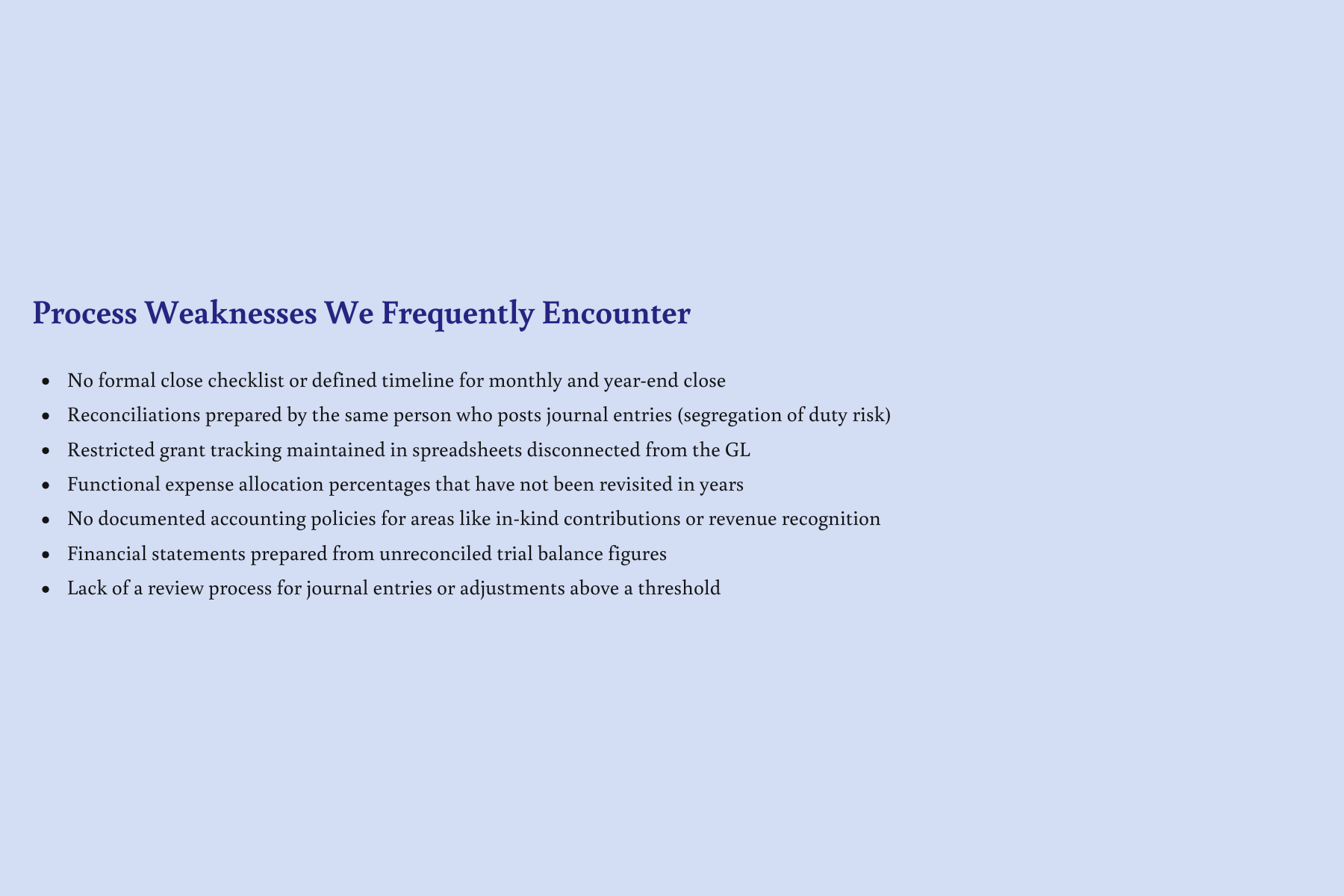
We document our findings in a practical memo: a clear, actionable summary of what we found and what we recommend. Many of our clients share this with their board's audit committee as evidence of proactive financial governance.
What to Expect When You Work With Solaris
We understand that bringing in an outside firm can feel like an admission that something is wrong. In our experience, it is actually the opposite. It is a sign that leadership understands the stakes and is committed to getting it right.
Here is what a typical year-end engagement looks like:
Week 1 — Discovery and Assessment:We review your trial balance, chart of accounts, key reconciliations, and any existing close documentation. We identify the gaps and prioritize them by audit risk and complexity.
Weeks 2 through 4 — GL Cleanup and Reconciliations:We work through the adjustments and reconciliations systematically, keeping you informed at each step. We document every entry and maintain a clear adjustment log.
Weeks 5 through 6 — Financial Statement Draft:We prepare a complete draft of your financial statements and footnotes, tied to the final adjusted trial balance. We review these with you before they go to the auditors.
Audit Fieldwork — Active Support:We remain available throughout audit fieldwork to respond to auditor requests, explain accounting positions, and ensure the process moves efficiently.
Post-Audit — Process Improvement:We deliver our close process assessment and recommendations, giving your team a roadmap for the year ahead.
June 30th Is Coming. Let Us Get You Ready.
The best time to start preparing for your year-end audit is before the stress sets in. Whether you are three months out or three weeks out, Solaris Accounting Advisory can help you close the gaps, produce financial statements you are proud of, and walk into audit fieldwork with confidence.
Our Small Business Services engagements are designed to be right-sized for your organization: not a one-size-fits-all subscription, but a focused, purposeful engagement built around what you actually need.